Fitted Wardrobes: Sliding vs Hinged Doors, Layouts and What Affects the Cost
Fitted wardrobes in Dubai: sliding vs hinged doors, walk-in or reach-in, interior layouts, finishes and lighting, and the factors that set the cost.
By MuteLine Team

Sliding doors suit fitted wardrobes in tighter bedrooms because they need no space to swing open; hinged doors give full access to the interior and suit rooms with clearance in front. The right choice depends on the room, the way you store your clothes and the look you want, and both can be built wall to wall and floor to ceiling.
Here is how to choose the doors, plan the inside and understand what drives the cost of a fitted wardrobe in Dubai.
Sliding wardrobe doors: pros and cons
Sliding doors run on a top and bottom track and glide past each other. What they do well:
- They need no space to swing open, so they suit smaller bedrooms and rooms where the bed sits close to the wardrobe
- Large panels give a clean, modern face and suit mirror, glass, lacquer or wood-look finishes
- Mirror panels can make a room feel larger
The trade-offs:
- You can only open part of the wardrobe at a time, usually a half or a third
- Internal drawers must be planned so they clear the overlap between doors
- Tracks need to be kept clean, and good runners matter for smooth, quiet movement
- The doors are heavy, so the fixings top and bottom must be level and secure
Hinged wardrobe doors: pros and cons
Hinged doors are the traditional choice, and still the most flexible inside. What they do well:
- They open fully, so you can see and reach everything at once
- Drawers, pull-out trays and shoe racks can go anywhere in the layout
- Soft-close hinges are quiet and easy to adjust
- They work well with handleless push-to-open or integrated grip profiles
The trade-offs:
- Each door needs clear space in front of it to swing
- Tall, wide doors can bow if the board or finish is poor, so door size and core material matter
- More doors mean more hinges and more alignment to maintain
A simple rule of thumb: if the space between the wardrobe and the bed or wall is tight, choose sliding. If you have room and want to see everything at once, choose hinged.
Walk-in or reach-in?
A reach-in wardrobe runs along one wall of the bedroom. A walk-in closet turns a small room, an alcove or part of a large bedroom into a dressing area with storage on two or three sides. Walk-ins often use open shelving, hanging rails and glass-fronted units with no doors at all, because the room itself keeps the dust out. They need enough floor space to stand and turn, and good lighting, since there is usually no window.
In many Dubai villas, a spare room next to the master bedroom becomes a walk-in; in apartments, a reach-in along the full wall is usually the most efficient use of space.
Planning the interior layout
Start with what you own, not with a standard layout. A useful exercise is to count your long items, short items, folded clothes and shoes, then plan zones for each:
- Long hanging for dresses, abayas, kanduras and coats
- Double hanging (two rails, one above the other) for shirts, jackets and trousers, which roughly doubles capacity in the same width
- Drawers for underwear, accessories and folded clothes, with dividers where useful
- Adjustable shelves for knitwear, bags and boxes
- Shoe storage: angled shelves, pull-out racks or a dedicated tall unit
- Accessory storage: tie and belt racks, watch and jewellery trays, pull-out mirrors and valet rails
- Top boxes above the rails for suitcases and seasonal items
Finishes and lighting
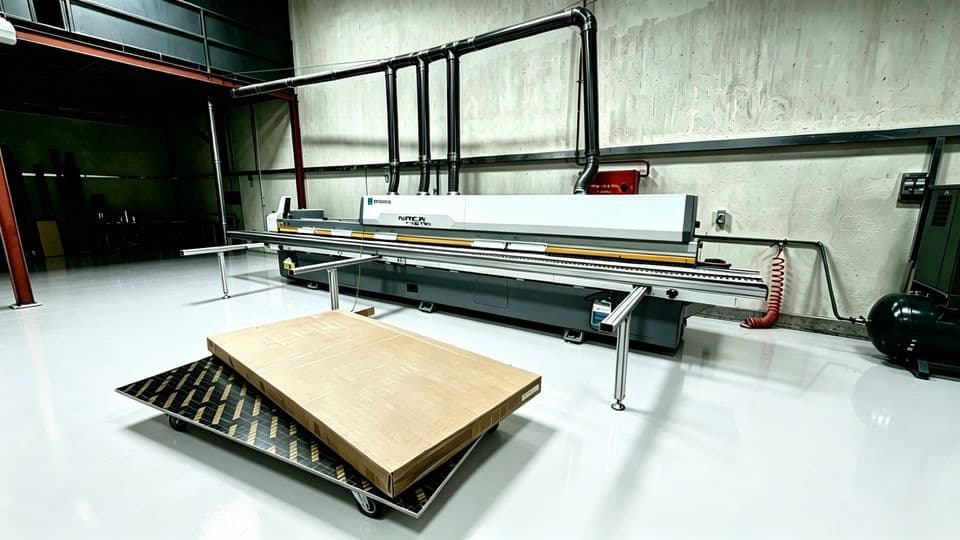
Fitted wardrobes are usually built from moisture-resistant boards with laminate, lacquer, veneer, acrylic, glass or mirror fronts. Inside, a light-coloured melamine makes it easier to see your clothes. Every exposed edge should be banded so the board stays sealed; we do this on our own edge bander, as shown on our panel cutting and edge banding page.
Lighting changes how a wardrobe works. LED strips in the hanging rails or along shelf fronts, switched by door or motion sensors, let you see colours properly even late at night. Plan the power points during design so cables stay hidden.
Measuring to wall and ceiling
A fitted wardrobe is built to the room, not the other way round. Walls in apartments and villas are rarely perfectly straight or square, and ceilings may slope slightly or carry bulkheads, AC grilles or sprinkler heads.
- Height is measured at several points, because floors and ceilings are rarely level
- Scribed panels and fillers close the gap to walls and ceiling, so there is no dust trap on top
- AC grilles, access panels, sockets and switches are planned around rather than covered
- Skirting is removed, or the wardrobe is scribed over it, for a clean fit
What affects the cost of a fitted wardrobe
There is no fixed price per wardrobe, because each one is built to its room. The main factors are:
- Size: the width and height, and whether it runs floor to ceiling
- Door type and number: sliding systems, hinged doors, mirror or glass panels
- Board and finish: laminate, lacquer, veneer, acrylic or a mix
- Interior fittings: drawers, pull-out shoe racks, accessory trays and pull-down rails for high hanging
- Lighting and sensors
- Walk-in features such as a central island, open display units or seating
- Site conditions: uneven walls, bulkheads, removal of existing wardrobes and access to the building
If you also want matching bedside tables, dressing tables or TV units, our custom furniture service can make them in the same finish.
Frequently asked questions
Are sliding wardrobes cheaper than hinged ones?
Not necessarily. A sliding system has fewer, larger doors but needs a quality track; hinged wardrobes need more doors and hinges. The finish and the interior usually affect the price more than the door type.
Can a wardrobe go all the way to the ceiling?
Yes. Floor-to-ceiling wardrobes look built-in, store more and leave no dusty gap on top. The top section is a good place for suitcases and seasonal clothes.
How do I stop clothes going musty in a humid climate?
Keep the room air-conditioned, avoid putting damp clothes away, and leave a small ventilation gap where the wardrobe stands against an outside wall. Moisture-resistant boards and sealed edges help the wardrobe itself last.
Do you install fitted wardrobes outside Dubai?
Yes. Our own team works in all seven emirates, including fitted wardrobes in Sharjah.
See our wardrobes and closets work, then book a free site visit. We measure the room, design the interior around what you own and give you a fixed, itemised quotation before we make anything.
Written by MuteLine Team, 20 Oct 2026
Back to the journal