The Best Kitchen Cabinet Materials for Dubai’s Heat and Humidity
The best kitchen cabinet materials for Dubai’s heat and humidity: moisture-resistant boards, door finishes, sealed edges and hardware that lasts.
By MuteLine Team

For kitchen cabinets in Dubai’s heat and humidity, the safest combination is a moisture-resistant MDF, particleboard or plywood carcass, a door finish that suits the way you cook, and edges that are sealed all round, especially at the sink and dishwasher. The board matters, but most kitchens fail at the edges first.
Why Dubai is hard on kitchen cabinets
A Dubai kitchen lives in two climates at once. Outside, the air is hot and humid, and near the coast, in areas such as Dubai Marina, Jumeirah or the Abu Dhabi Corniche, it also carries salt. Inside, air-conditioning keeps the room cool and dry. Every boiling kettle and finished dishwasher cycle meets the cabinets with warm, wet air. Wood-based boards take on moisture and release it again, and over time that shows up as swollen edges, lifting finishes and doors that no longer line up.
The areas under the most stress are always the same:
- The sink base, where splashes and small leaks reach the board
- The panels either side of the dishwasher, which get a blast of steam when the door opens
- The tall unit beside the oven, which goes through repeated heating and cooling
- Kick plinths, which meet mop water every day
Carcass boards: the box behind the doors
The carcass is the cabinet body. It is hidden, which is exactly why corners get cut there.
Moisture-resistant MDF
Medium-density fibreboard made with a moisture-resistant resin, often recognisable by its green core. It machines cleanly, takes paint and lacquer well and stays flat, so it is a common choice for both carcasses and painted doors. It is moisture-resistant, not waterproof: an exposed, unsealed edge will still swell if water sits on it.
Moisture-resistant particleboard
Particleboard made with moisture-resistant binders is a sound, economical carcass material when it comes faced with melamine and every cut edge is banded. Standard particleboard is the material most likely to crumble under a leaking sink, so ask which grade is being quoted.
Plywood
Plywood is built from cross-laid layers of veneer, which makes it strong, stable and good at holding screws. Water-resistant grades are a sensible upgrade for the sink base and the units around the dishwasher. Its layered edges need banding for a clean look.
Many good kitchens mix the two: moisture-resistant MDF or particleboard for most cabinets, plywood under the sink.
Door finishes compared
All of these finishes can work in Dubai when the core board and the edges are right; the choice is mostly about looks and how you live with them.
- Lacquer (painted): seamless, in any colour, matt or gloss. Ideal for handleless designs, but it can chip on a hard knock.
- Laminate and HPL: a hard-wearing decorative layer pressed onto the board. High-pressure laminate (HPL) resists scratches, heat and moisture well, making it one of the most practical finishes for family kitchens.
- Wood veneer: a thin layer of real timber on a stable core. It gives the warmth of wood with far less movement than solid timber, as long as it is properly sealed.
- Acrylic: a high-gloss or super-matt face with a deep, even colour. Easy to wipe, though gloss shows fine scratches.
- Solid wood: classic and repairable, but timber moves as humidity changes, so frame-and-panel doors that allow for movement behave better than wide slabs.
Edge banding: why sealed edges matter near sinks and dishwashers
Every time a board is cut, its core is exposed. Moisture gets into MDF and particleboard through those cut edges far faster than through a faced surface, so the quality of the edge banding decides how long a cabinet lasts near water.
Good banding is applied by machine with even pressure and heat, then trimmed flush, corner-rounded and polished, so there is no gap for water to creep behind. Points worth checking:
- All four edges of every door and every exposed carcass edge are banded, not just the front
- Cut-outs for the sink, hob and pipes are sealed before installation
- Ask which adhesive is used: polyurethane (PUR) glues cope with moisture and heat better than standard hot-melt
- The panels beside the dishwasher are protected on the face that meets the steam
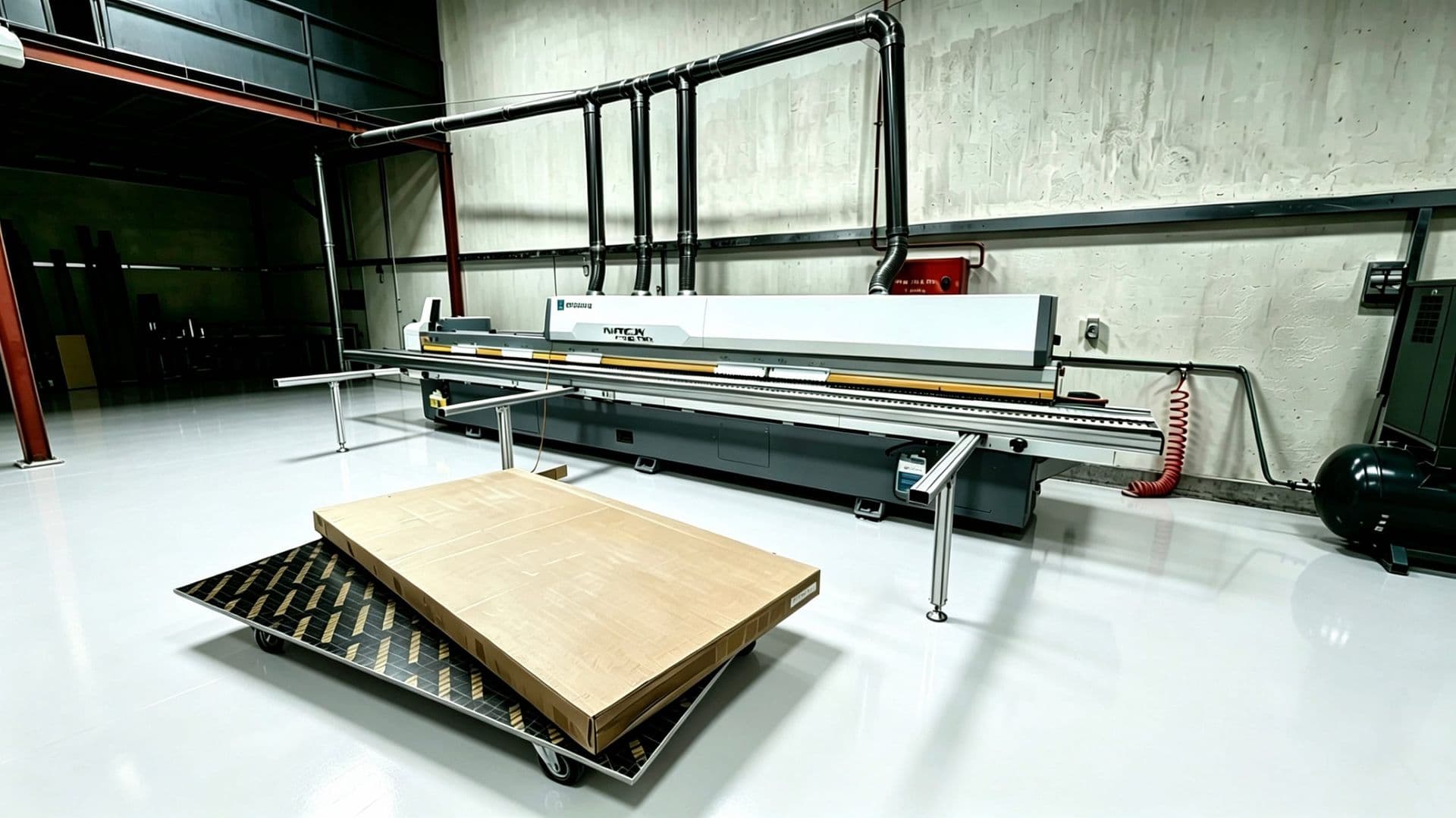
At Mute Line we cut boards on our own panel saw, with a scoring blade that keeps laminated faces chip-free, and band every edge on our own edge bander in Jebel Ali. You can see how that works on our panel cutting and edge banding page, and read more about our manufacturing facility in Dubai.
Hardware that copes with the climate
In humid, sometimes salty air, cheaper hinges and runners can rust and soft-close dampers can weaken.
- Choose branded hinges and runners with a corrosion-resistant finish
- Under the sink, go for stainless steel or coated accessories and a removable base mat
- Specify full-extension drawers for pots and pans; they carry weight better than shelves behind doors
Worktops, in general terms
The worktop protects the cabinets beneath it, so it belongs in this guide too. Quartz, granite, porcelain or sintered stone, solid surface and laminate are all used in UAE kitchens. Stone and porcelain resist heat and water; laminate is practical where budget matters. Whatever you choose, the joint between worktop and wall, and around the sink, must be sealed so water cannot run down the back of the cabinets.
Simple maintenance that keeps cabinets looking new
- Wipe up splashes around the sink and dishwasher straight away
- Run the extractor hood whenever you cook
- Clean with a soft cloth and mild soap; avoid abrasive pads on lacquer and acrylic
- Check the sink base and the sealant around the worktop now and then, and reseal if it has cracked
Frequently asked questions
Is MDF or plywood better for kitchen cabinets in Dubai?
Both work well in moisture-resistant grades with every edge banded. Plywood holds screws better and copes better with a leak, so it suits the sink base; moisture-resistant MDF is flatter and better for painted doors.
Are solid wood cabinets a bad idea in the UAE?
Not necessarily, but solid timber moves as humidity changes. Veneer on a stable core gives a similar look with less risk; if you want solid wood, choose designs that allow for movement.
Do you make kitchens outside Dubai?
Yes. Our own team measures, makes and installs across all seven emirates, including kitchen cabinets in Abu Dhabi.
Planning a new kitchen? See our kitchen and cabinet service, then book a free site visit. We measure the space, recommend materials for how you use it and give you a fixed, itemised quotation before anything is made.
Written by MuteLine Team, 20 Oct 2026
Back to the journal