NRC, STC and Rw Explained: How to Read Acoustic Data Sheets
NRC, STC and Rw explained in plain terms: what each acoustic rating measures, why absorption is not insulation, and what to ask before you buy.
By MuteLine Team

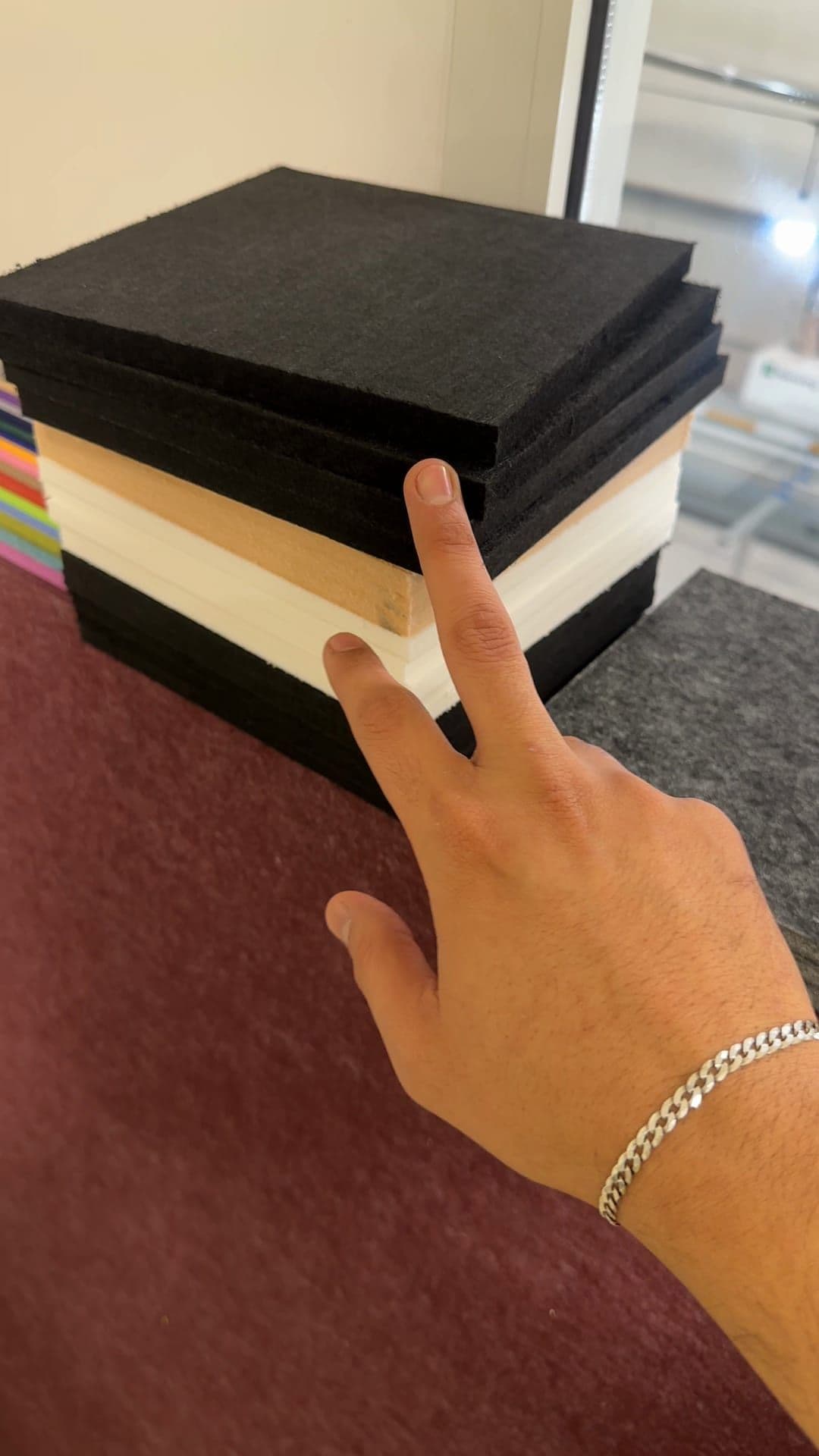
NRC tells you how much sound a material absorbs, which controls echo inside a room. STC and Rw tell you how well a wall, floor, door or window blocks sound passing through it. They measure different things, so a panel with a high NRC will not stop noise from the next room.
Here is how to read each rating on an acoustic data sheet, and the questions to ask before you choose a product.
Absorption vs insulation: two different jobs
Most confusion comes from mixing up these two ideas:
- Sound absorption: how much sound a surface soaks up instead of reflecting it back into the room. Soft, porous materials such as PET felt, mineral wool and acoustic foam absorb well. Ratings: NRC, αw and absorption class.
- Sound insulation: how much sound a construction stops from passing through it. Heavy, airtight and decoupled constructions insulate well. Ratings: STC and Rw for airborne sound; IIC and Ln,w for impact sound such as footsteps.
Absorbers are usually lightweight and porous, which is exactly why sound passes through them easily. Insulation needs mass, airtightness and, ideally, decoupling of one side of the construction from the other.
NRC: Noise Reduction Coefficient
NRC is a single-number rating for sound absorption, used mainly in North American data and tested to ASTM C423. It is the average of the material’s absorption coefficients at four frequencies, 250, 500, 1,000 and 2,000 Hz, rounded to the nearest 0.05.
- An NRC of 0 means the surface reflects practically all sound, like glass or polished stone.
- An NRC close to 1 means it absorbs nearly all the sound that reaches it in that frequency range.
- Laboratory results can come out slightly above 1 because of the way samples are measured. This does not mean a panel absorbs more sound than reaches it.
Because NRC averages mid frequencies only, it says little about bass. Two panels with the same NRC can behave very differently at 125 Hz, which matters for home cinemas, music rooms and plant rooms. Ask for the full table of absorption coefficients by frequency.
αw and absorption classes
In European and international data, you will often see the weighted sound absorption coefficient, αw (alpha-w), calculated to ISO 11654 from tests to ISO 354. Like NRC it runs from 0 to 1, but it is calculated differently, so the two numbers are not directly interchangeable. ISO 11654 also groups results into absorption classes from A, the highest, to E, the lowest.
STC: Sound Transmission Class
STC rates how well a partition reduces airborne sound passing through it. It comes from laboratory tests to ASTM E90 and is calculated using ASTM E413. The higher the number, the better the isolation. It is given for complete constructions, such as a wall build-up, a door set or a window, not for a single absorber panel.
As a rule of thumb, a reduction of about 10 dB is heard as roughly half as loud. STC focuses on the speech range, so it can flatter a wall’s performance against deep bass from music or a home cinema.
Rw: Weighted Sound Reduction Index
Rw is the international counterpart, from laboratory tests to ISO 10140 and rated using ISO 717-1. As with STC, higher is better, and the values for the same construction are often similar, but the methods differ, so they should not be treated as identical.
Rw is often shown with correction terms, for example Rw (C; Ctr). The Ctr term adjusts for low-frequency noise such as road traffic and is usually negative, so Rw + Ctr gives a more realistic picture for traffic noise or bass-heavy sound.
Lab results vs site results
Data sheet figures come from laboratories under controlled conditions. On site, sound also travels around a wall, through the floor, ceiling void, ducts and gaps. This is called flanking, and it means the performance you get in the building is usually lower than the lab figure. Field measurements use different symbols, such as R′w or DnT,w in ISO terms and FSTC in ASTM terms. Careful detailing and sealing narrow the gap.
How mounting changes absorption results
An absorber’s performance depends on how it is fixed as well as what it is made of:
- Thickness: thicker porous material absorbs lower frequencies.
- Air gap: spacing a panel off the wall, or suspending it below a ceiling, usually improves low-frequency absorption.
- Backing: panels glued directly to a hard wall typically perform below the same panels tested with an air gap.
- Facings and grooves: perforations, slots and fabric facings change how sound enters the panel.
Test reports state the mounting used. ASTM E795 names mountings by type, for example Type A for material placed directly against a hard surface and Type E-400 for a 400 mm air space, typical of suspended ceilings. Make sure the mounting in the report matches your installation.
What to ask a supplier
- Is this rating for absorption or for insulation?
- Which standard was the product tested to, and by which laboratory?
- What thickness and mounting were tested, and does that match our installation?
- Can you send the full frequency table, not just the single number?
- For walls, doors and floors: is the figure a lab rating or a site measurement, and does it apply to the complete construction?
- What fire information does the data sheet include?
Every acoustic product we supply has a technical data sheet, available on request, including our PET acoustic panels, sound insulation and mass-loaded vinyl.
Frequently asked questions
Is a higher NRC always better?
Not always. Too much absorption can make a room feel dead, and NRC ignores bass. The right amount depends on the room’s size, finishes and use.
Can acoustic panels improve a wall’s STC?
Only slightly, if at all. Panels reduce echo; to block sound through a wall you need added mass, decoupling and sealing, which is the job of our soundproofing service.
Are STC and Rw the same?
They are similar in concept and often close in value, but the test methods and frequency ranges differ, so compare like with like.
Which rating do I need?
It depends on the noise and the room. Tell us what you are trying to solve, whether echo or noise from outside, and we will recommend products and send their data sheets.
For help reading a specification or choosing a product, contact our team or message us on WhatsApp at +971 52 237 5959, Monday to Saturday, 8am to 6pm.
Written by MuteLine Team, 20 Oct 2026
Back to the journal