PET Felt Acoustic Panels vs Acoustic Foam: Which Should You Choose?
PET felt acoustic panels vs acoustic foam: a fair comparison of looks, durability, fire behaviour and Dubai heat, and where each one makes sense.
By MuteLine Team


For most offices, homes, restaurants and hotels in Dubai, PET felt acoustic panels are the better all-round choice: they look like a finished wall, are made from recycled polyester and are fire-retardant. Acoustic foam still has its place, mainly in recording studios and rooms where budget matters more than appearance.
Below is a fair, side-by-side look at both materials, so you can choose the right one for your space.
Both do the same basic job
PET panels and acoustic foam are both porous absorbers. Sound enters the open structure of the material, and friction between the moving air and the fibres or cells turns a small part of that sound energy into heat. The result is less echo and a shorter reverberation time, so speech is clearer and the room feels calmer.
Neither product is soundproofing. Absorbers improve the sound inside a room; they do very little to stop noise passing through a wall, floor or door. If your problem is a neighbour, a road or a plant room, you need mass, decoupling and sealing, which is what our soundproofing service is for.
For a similar thickness and mounting, the two materials can perform in a similar range at mid and high frequencies. Thicker material and an air gap behind it help with lower frequencies in both cases. That is why it is worth comparing the tested data of the actual products you are considering, rather than the material name alone.
Appearance and design freedom
This is where the two differ most. Acoustic foam is usually sold as wedge, pyramid or egg-crate tiles in a limited range of colours. It reads as technical treatment, which suits a studio but rarely a reception, a living room or a restaurant.
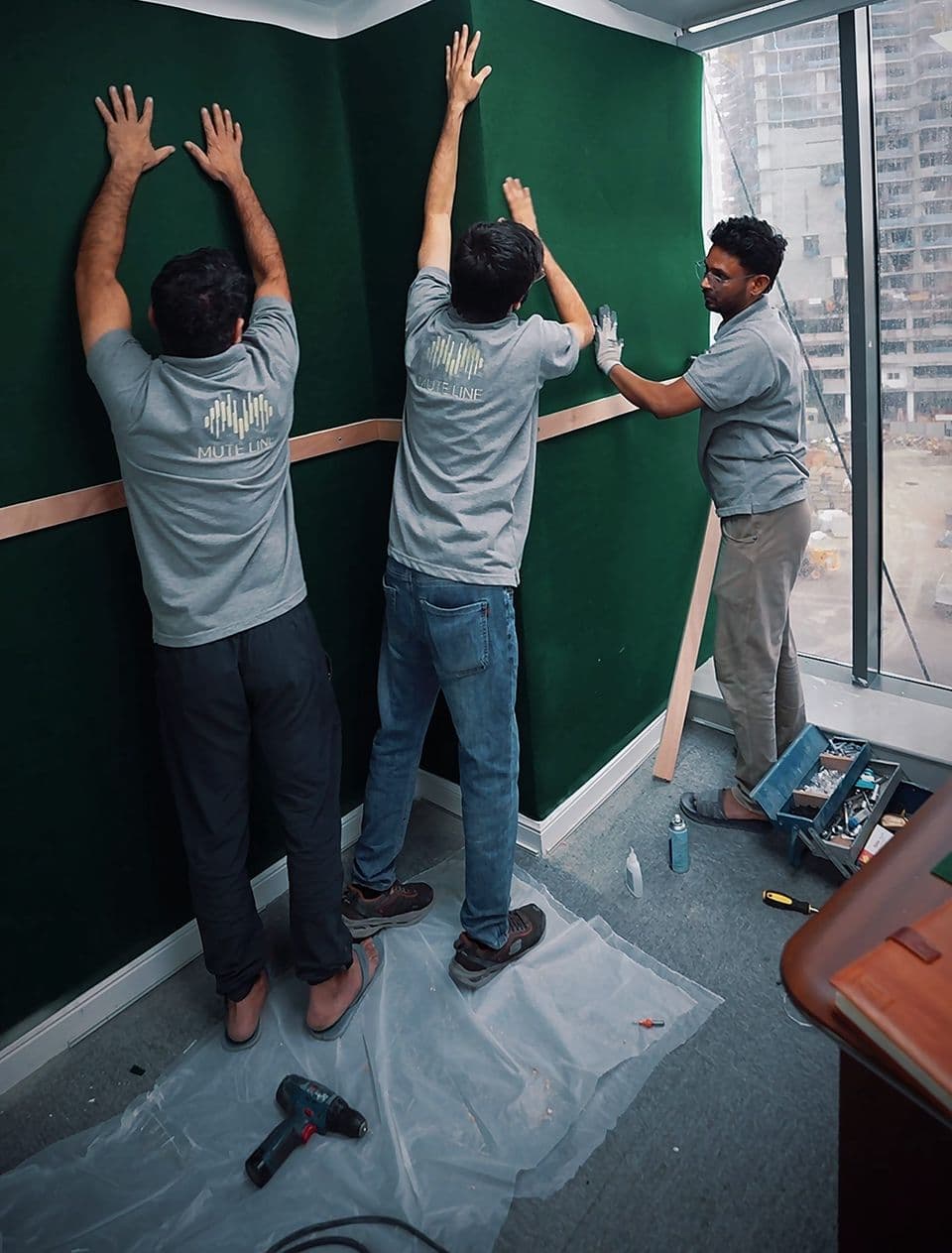
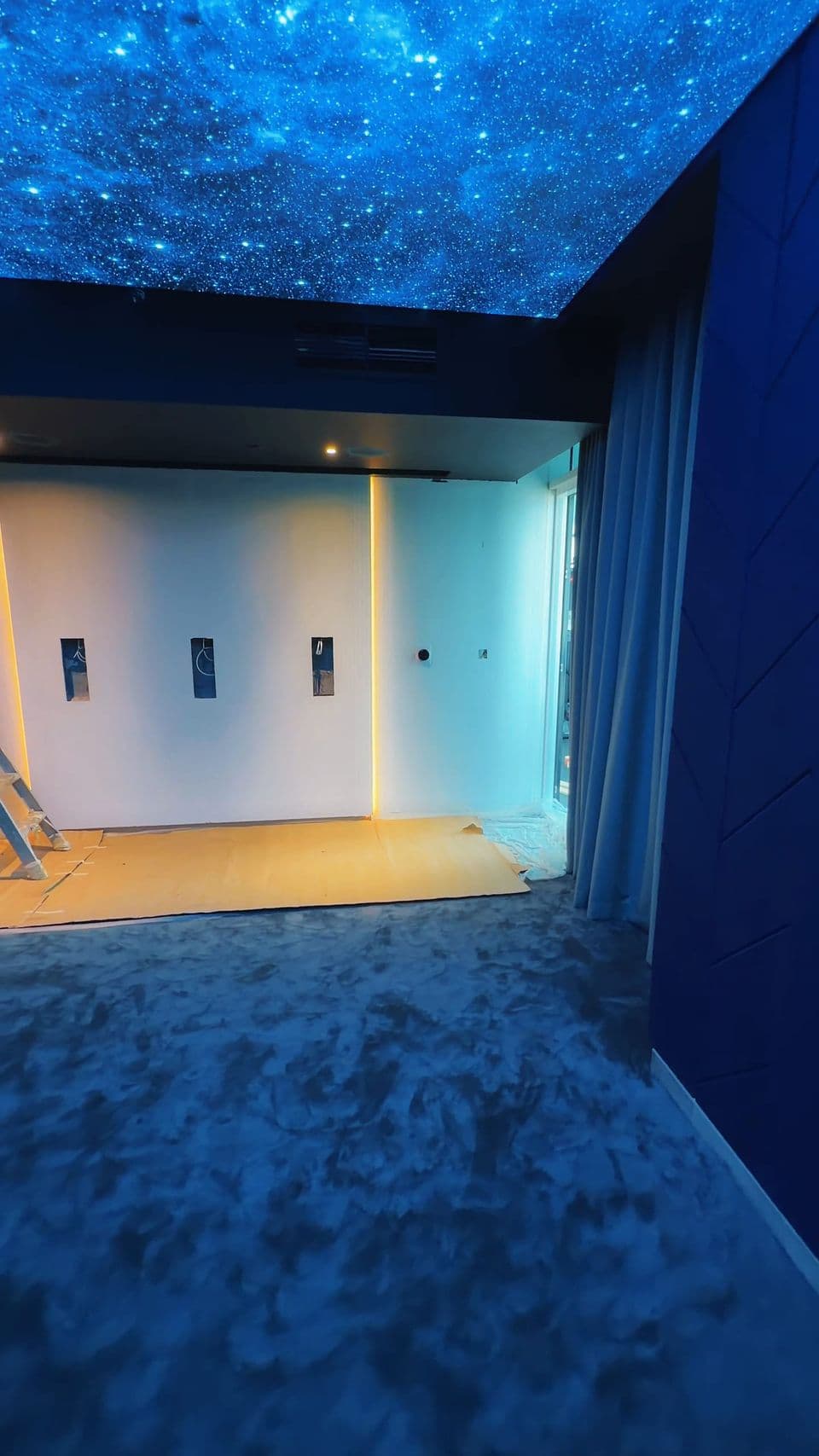
PET felt is a dense, smooth sheet that comes in a wide range of colours and can be cut to almost any size or shape. Our PET acoustic panels are cut to file on our own CNC in Jebel Ali at a tolerance of ±0.1 mm, with V-grooves, patterns, lettering and logos, so the acoustic treatment can become the feature wall itself. Our guide to PET panels with CNC grooving shows what is possible.
Durability and cleaning
PET felt is firm enough to be used as wall cladding, ceiling baffles and desk screens, and it keeps its shape in busy spaces. Dust can be removed with a soft brush or a vacuum on low suction, and light marks can often be spot-cleaned; follow the care advice on the data sheet for the specific product.
Open-cell foam is softer and easier to dent or tear. Polyurethane foam in particular can discolour and become brittle as it ages, especially with sunlight and heat, and its open, textured surface collects dust that is harder to clean. On a studio wall that nobody touches this matters less; in a corridor or a café it matters a lot.
Fire behaviour
Fire performance should always be checked product by product, against the requirement in your project specification or the building’s approval process.
- PET acoustic panels: the PET panels we supply are fire-retardant, and every product has a technical data sheet that we send on request for your submittals.
- Acoustic foam: fire behaviour varies widely from product to product. Standard polyurethane foam is combustible, some foams are made with fire-retardant additives, and melamine foam behaves differently again. Ask the supplier for the test report and the standard it was tested to.
For commercial interiors in Dubai, consultants and building management usually want to see fire information before they approve a wall or ceiling finish, so ask for it before you choose, not after.
Recycled content
PET panels are made from recycled polyester fibre, the same family of plastic used in drinks bottles, which helps on projects that track the sustainability of their materials. Most acoustic foam is made from new polyurethane, although some products with recycled content exist. Again, the data sheet is the place to check.
Dubai heat and humidity
Interiors here deal with strong sun through glazing, air conditioning that runs most of the year, and humidity that rises quickly when the AC is off. Polyester fibre does not soak up moisture the way natural fibres can, and PET panels keep their shape well in air-conditioned interiors. The acoustic products we supply are selected for Dubai’s heat and humidity. Foam can work well in a controlled studio, but avoid placing it in direct sunlight or near heat sources.
Which should you choose?
- Offices and meeting rooms: PET panels, for the finished look, colour choice and durability in shared spaces.
- Homes, majlis and bedrooms: PET panels or fabric-wrapped panels that sit naturally with the interior design.
- Restaurants, cafés and hotels: PET wall panels, ceiling baffles or CNC-cut feature walls that cope with cleaning and daily wear.
- Recording studios and rehearsal rooms: either can work. Foam is common for budget treatment; PET, acoustic wood and diffusers suit a studio that clients will see.
- Temporary or hidden treatment: foam can be a practical, low-cost option.
If you are unsure, tell us about the room and how it is used. Our team will recommend a treatment, send the data sheets for the products we propose and, in the UAE, handle the full PET acoustic panel supply and installation.
Frequently asked questions
Is PET felt better than foam for sound absorption?
Not automatically. Absorption depends on thickness, density, mounting and air gap as much as on the material. Compare the tested absorption data of the specific products, in the way they will be fixed.
Can PET panels be installed over existing walls?
Yes. PET panels are lightweight and are usually fixed to the existing wall or ceiling with adhesive, mechanical fixings or a track system, so they rarely need any demolition.
Do PET panels come in custom colours and shapes?
Yes. We supply PET panels in custom colours and sizes, and cut shapes, grooves, lettering and logos to your .DXF, .DWG, .AI or .PDF file on our own CNC.
Do you supply outside the UAE?
We supply acoustic products to Saudi Arabia and the other GCC countries, without installation. Inside the UAE, our own team measures, makes and installs in all seven emirates.
To compare options for your space, request a free consultation and an itemised quotation, or message us on WhatsApp at +971 52 237 5959, Monday to Saturday, 8am to 6pm.
Written by MuteLine Team, 20 Oct 2026
Back to the journal