Home Cinema Room Design for Villas in Dubai: A Practical Guide
Home cinema room design for villas in Dubai: choosing the room, isolation, acoustic treatment, seating, star ceilings and what to send for a quote.
By MuteLine Team

A good home cinema room in a Dubai villa comes down to four steps done in the right order: choose a suitable room, stop sound getting in and out, treat the acoustics inside, then design the seating, screen, lighting and joinery around them. Get the first two right and everything else is easier.
This guide follows the order in which we plan home cinemas and studios, from the first site visit to the final finish.
Choosing the right room
In most villas, the best cinema rooms are basements, ground-floor rooms away from bedrooms, or rooms above a garage. Look for:
- Few or no windows, or windows you are happy to block, since glass lets sound out and light in.
- A rectangular plan rather than a square one; in a square room the resonances stack up at the same frequencies, which makes bass uneven.
- Enough ceiling height for a raised rear row and, if you want them, ceiling speakers and a star ceiling.
- Distance from bedrooms and the majlis, or at least a corridor or wardrobe in between.
- A nearby space for the equipment and the AC unit, so their noise stays outside the room.
Isolation: walls, ceiling, door and AC
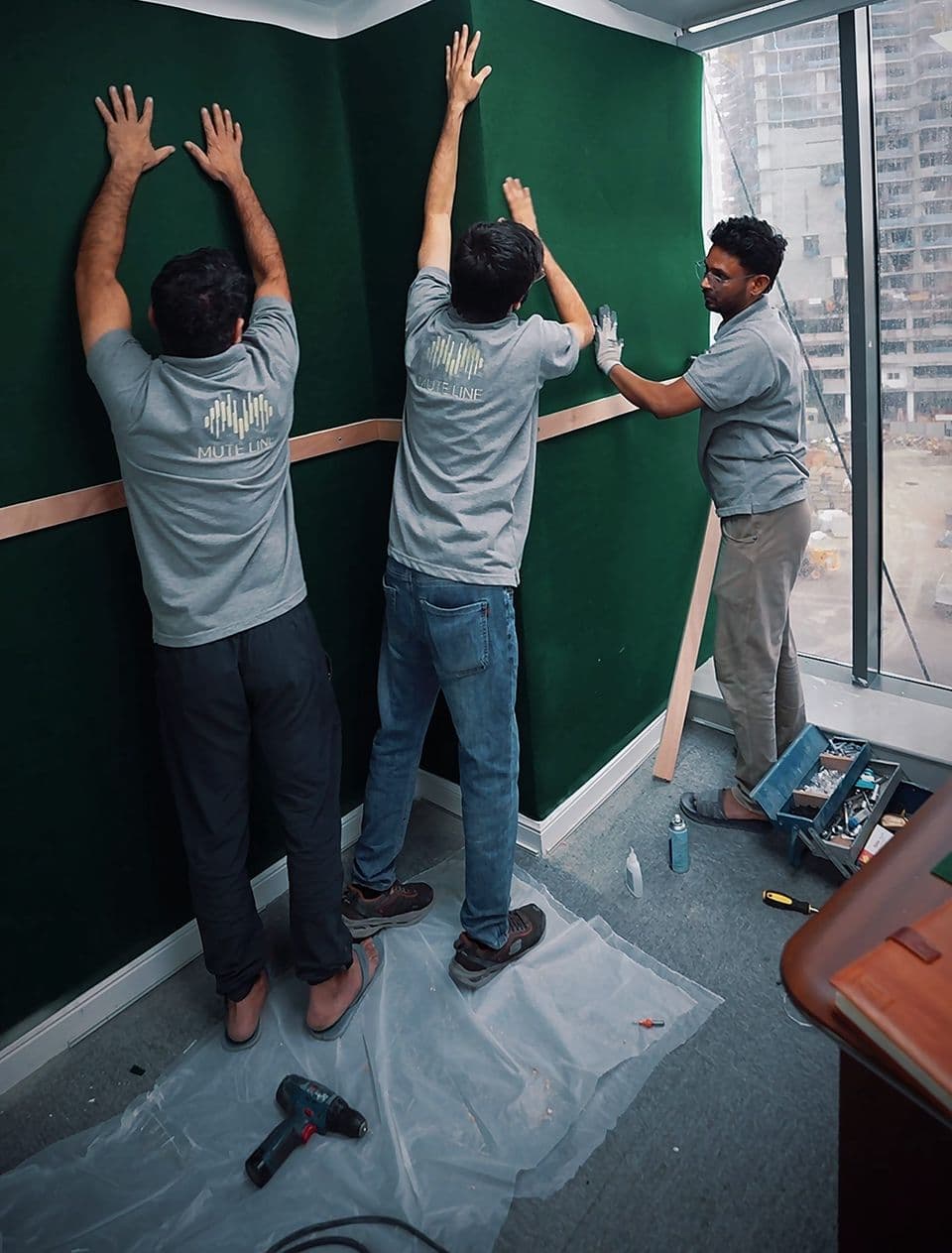
Isolation keeps the film’s sound from waking the house and keeps household noise out of the film. It relies on three principles: mass, decoupling and airtight sealing. Low-frequency sound from a subwoofer is the hardest to contain, so the construction as a whole matters more than any single product.
- Walls: add mass with layered boards and mass-loaded vinyl, and decouple the new lining from the existing wall where space allows, with insulation in the cavity.
- Ceiling: if there is a room above, a decoupled ceiling with insulation reduces airborne sound going up and footsteps coming down.
- Door: a hollow interior door undoes the rest of the work. A solid acoustic door with perimeter seals and a drop-down bottom seal is essential.
- Sockets, pipes and gaps: every penetration is sealed with acoustic sealant, because sound travels through any air path.
- Air conditioning: in Dubai the AC runs most of the year, so it must be quiet. Keep the indoor unit outside the room where possible and use lined ducts with large, low-velocity grilles.
We supply wooden acoustic doors and door seals for exactly this reason: the entrance should not become the weak point of the room.
Acoustic treatment inside the room
Once the room is isolated, it needs treating so dialogue is clear and effects sound precise.
- Absorption at the first reflection points on the side walls and ceiling, so the sound from the front speakers reaches you before its echoes do.
- Bass control in the corners and on the rear wall, using thicker absorbers, since low frequencies build up there.
- Diffusion on the rear wall and upper side walls to scatter sound evenly, so the room sounds open rather than dead.
A balance of absorption and sound diffusers gives a room that is controlled without feeling airless. PET panels, fabric-wrapped panels and slatted acoustic wood can all be shaped into the interior design, so the treatment does not look like treatment.
Seating and screen layout basics
Plan the screen, seats and speakers together, before any walls are lined.
- Screen size and viewing distance: a common guideline is for the screen to fill roughly 30 to 40 degrees of your field of view from the main seat. Your AV designer will confirm the size for the projector or TV you choose.
- Main seat position: avoid placing the main row tight against the back wall or exactly halfway along the room, where bass is often uneven.
- Rows and risers: with two rows, a raised platform for the rear row gives a clear sightline. The riser can be built hollow and filled with insulation so it doesn’t boom.
- Speakers: decide early whether you want in-wall or ceiling speakers, including overhead speakers for formats such as Dolby Atmos, so the backing and cable routes are built before finishing.
- Screen type: an acoustically transparent screen lets the front speakers sit behind it for a cleaner look.
Lighting and star ceilings
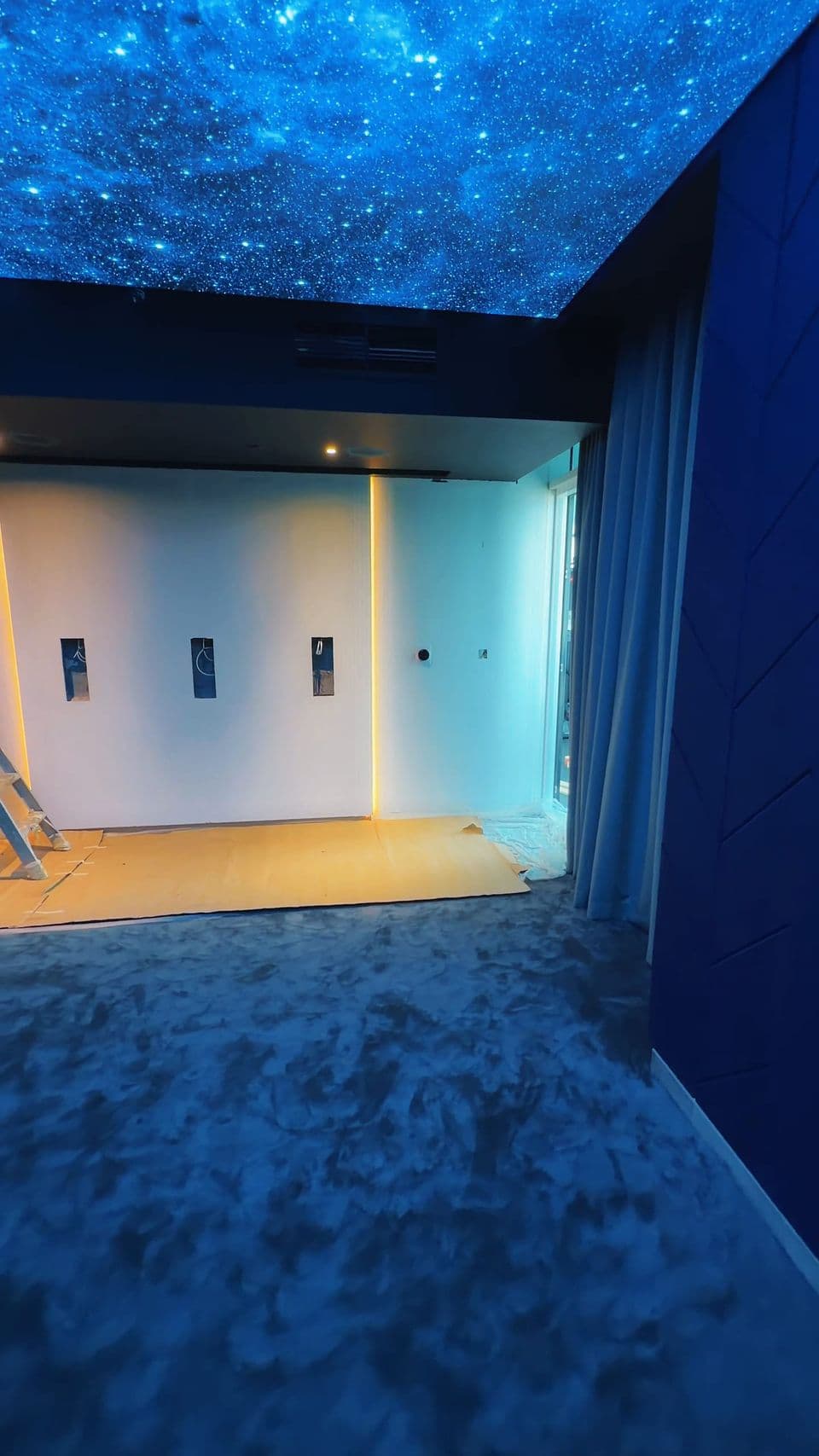
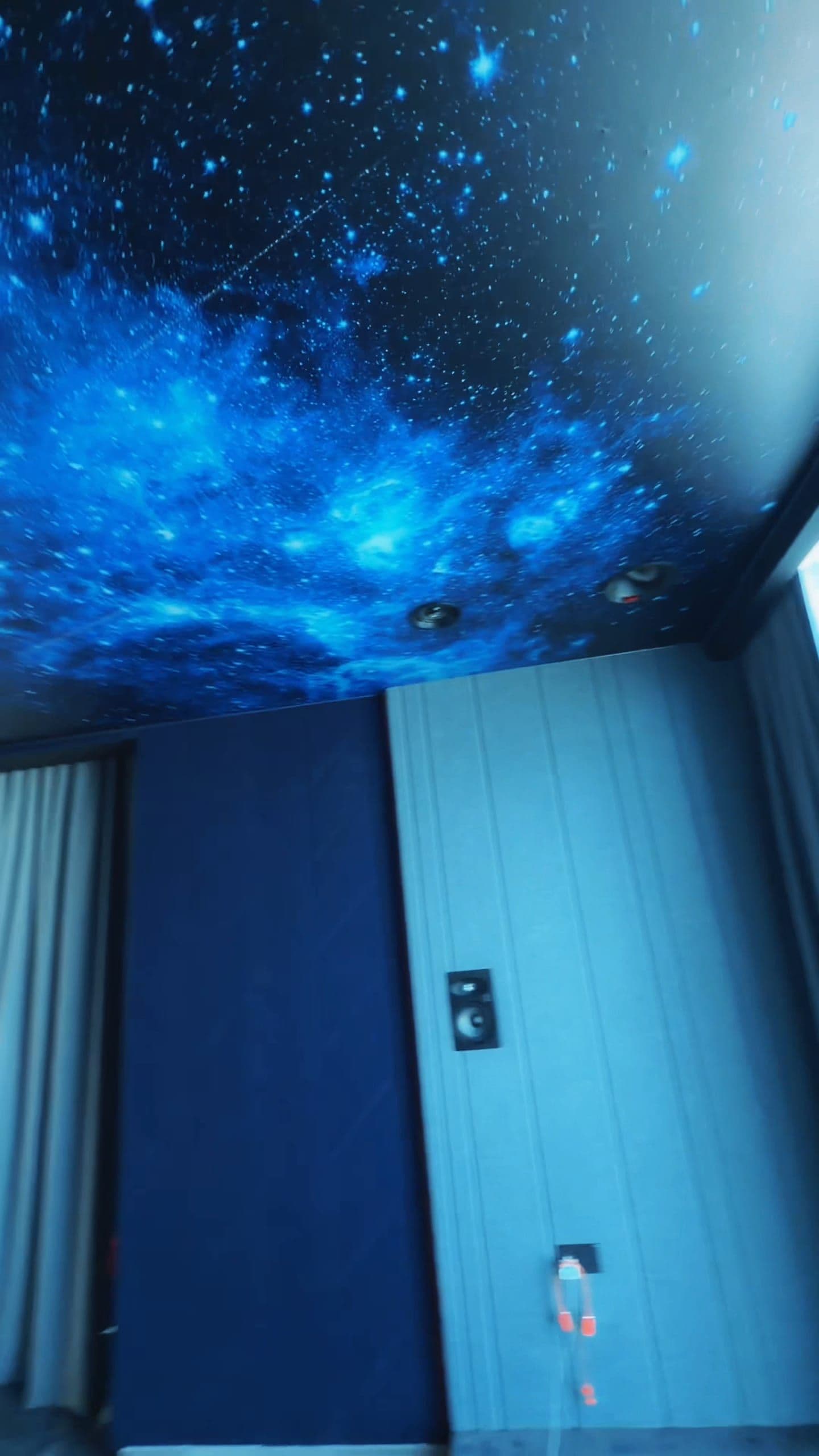
Cinema lighting should be dimmable and controlled from the seat: soft wall washers, step and aisle lights, and a low glow for intervals. A fibre-optic star ceiling is a popular finishing touch. The light source sits outside the room or in an accessible void where its fan won’t be heard, and the fibres pass through an acoustic ceiling panel, so the ceiling keeps absorbing sound while it glows.
Joinery and cable management
Good joinery is what makes a cinema feel finished, and we make ours in our own factory in Jebel Ali. Plan for:
- An equipment cabinet or rack with ventilation and rear access, ideally outside the room or in a closed, ventilated cupboard.
- Conduits and cable routes planned before the walls are lined, with spare capacity for future upgrades.
- Access panels for the projector, speakers and AC, so servicing doesn’t mean removing finishes.
What we need for a quote
- A floor plan or rough dimensions, including ceiling height and the position of doors, windows and AC.
- Photos or a short video of the room, and what is above it and next to it.
- How many seats you want, and whether you prefer a projector or a large TV.
- Any AV equipment already chosen, or your AV designer’s speaker layout.
- The look you want: a reference image, colours or materials.
- The location of your villa.
After a free site visit, we give you a fixed, itemised quotation and a handover date before any work starts. Our team works in all seven emirates, including home cinemas in Abu Dhabi.
Frequently asked questions
Can an existing villa room become a home cinema?
Yes. Most villa cinemas are converted from an existing room. The new wall and ceiling linings take up some space, so a site visit to measure is the first step.
How do I stop the cinema disturbing the rest of the house?
Combine mass, decoupled linings, airtight sealing and an acoustic door, and keep AC and equipment noise outside the room. Acoustic panels alone will not contain the sound.
Can the room also be used for music or gaming?
Yes. The same isolation and treatment work for music practice, gaming or a podcast set-up. Tell us how you plan to use the room so we can balance the treatment.
Planning a cinema room? Book a free site visit, or message us on WhatsApp at +971 52 237 5959, Monday to Saturday, 8am to 6pm.
Written by MuteLine Team, 20 Oct 2026
Back to the journal